Sep 3, 2026
We Did Not Teach HR to Prompt AI. We Built a Live Résumé-Screening Agent With Them.
A practical, step-by-step guide to building an evidence-based résumé-screening agent with human control.

1,000 Résumés. One Human Decision Queue.
A team walked into our workshop with a real HR bottleneck: more than 1,000 résumés and no fast, consistent way to review them.
We did not give them another tool demonstration. We built a working résumé-screening agent with Claude, live in the room.
Takeaway
Do not ask AI to choose the candidate. Ask it to prepare better evidence for a human decision.
We did not automate hiring.
We redesigned the first review.
The agent had one disciplined job: turn an unstructured pile of applications into a consistent, explainable queue for people to review.
Extract the same job-relevant evidence from every résumé
Score only against an approved role scorecard
Flag missing, uncertain or contradictory information
Create a prioritised queue for human review
Takeaway
The right role for AI here is decision support, not automated rejection.
Build This Résumé-Screening Agent in 30 Minutes
Start with fictional résumés. Use real candidate information only after your HR, legal and information-security teams approve the process.
Step 1. Create one Claude Project
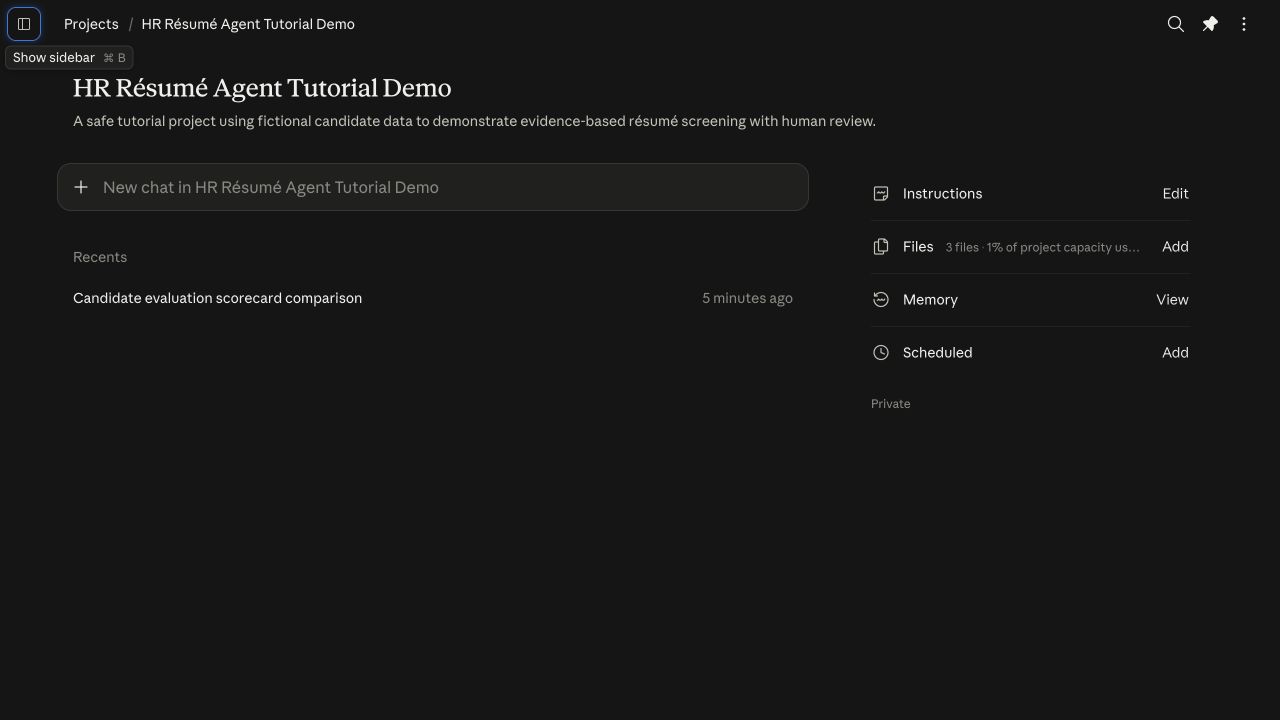
In Claude, open Projects and create a project for the role. Give it a clear name such as HR Résumé Agent Tutorial Demo. Keep one project per role so the context does not get mixed.
Step 2. Prepare three simple files
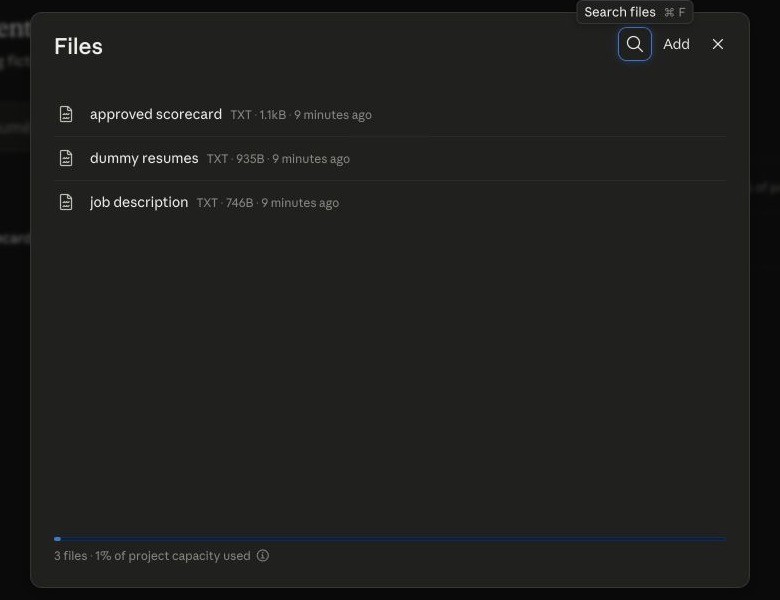
Add the role description, the approved scorecard and a small set of fictional test résumés. The scorecard should define each criterion, its weight and what a low, medium or high score means.
job-description.txt: responsibilities, must-have requirements and useful context
approved-scorecard.txt: criteria, weights and scoring definitions
dummy-resumes.txt: three to seven fictional candidates with different evidence patterns
Step 3. Add the operating rules
Open Project Instructions and paste rules that keep the review evidence-based and human-controlled.

Copy this instruction:
You are a recruitment screening assistant. Review every résumé only against the approved scorecard. Extract evidence for every criterion. Score only with the supplied definitions. Write Not found when evidence is missing. Do not infer protected characteristics. Explain every score with evidence from the résumé. Return a comparison table with total score, review band, evidence, gaps and questions for a human reviewer. Never make a final hiring or rejection decision. End every output with: Human validation required.
Step 4. Run one controlled test
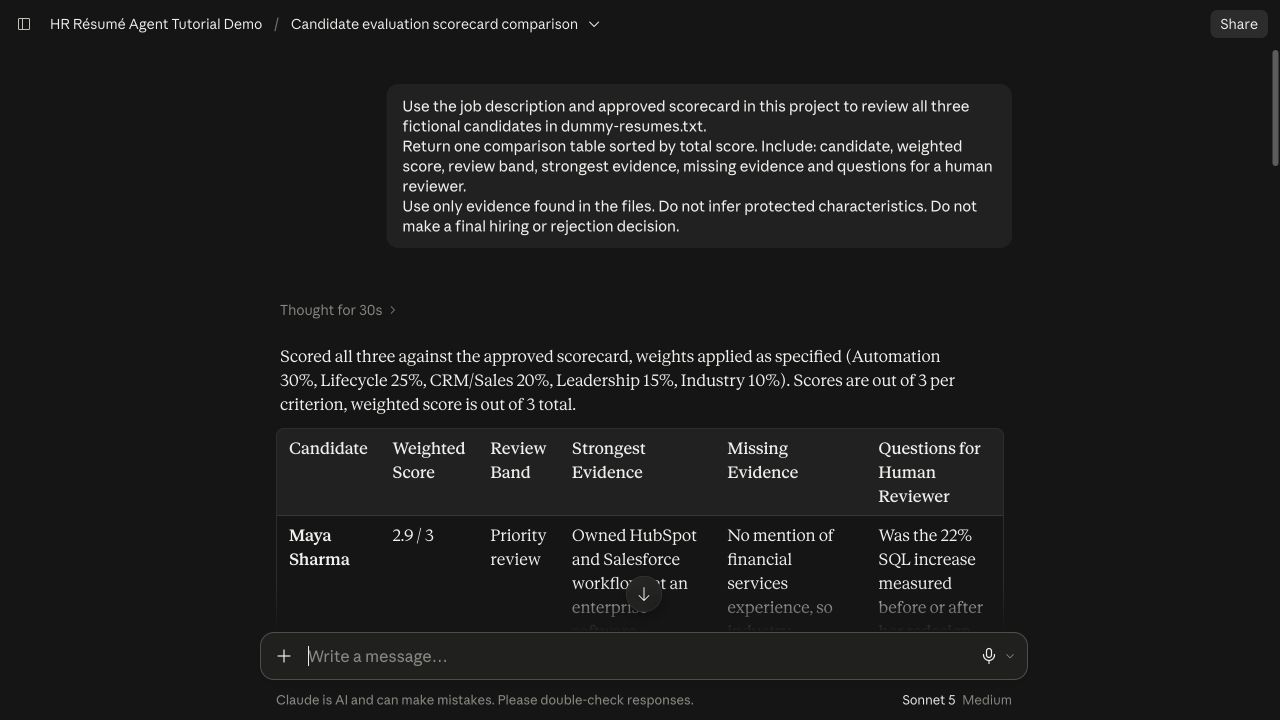
Ask Claude to review only the fictional candidates. Require one comparison table and insist that every score is tied to visible evidence.
Copy this test prompt:
Use the job description and approved scorecard in this project to review all fictional candidates in dummy-resumes.txt. Return one comparison table sorted by total score. Include candidate, weighted score, review band, strongest evidence, missing evidence and questions for a human reviewer. Use only evidence found in the files. Do not infer protected characteristics. Do not make a final hiring or rejection decision.
Step 5. Inspect the table, not just the ranking
Check whether every score has evidence, whether missing information is labelled clearly, and whether the questions are genuinely job-related. A neat table is not proof that the reasoning is sound.
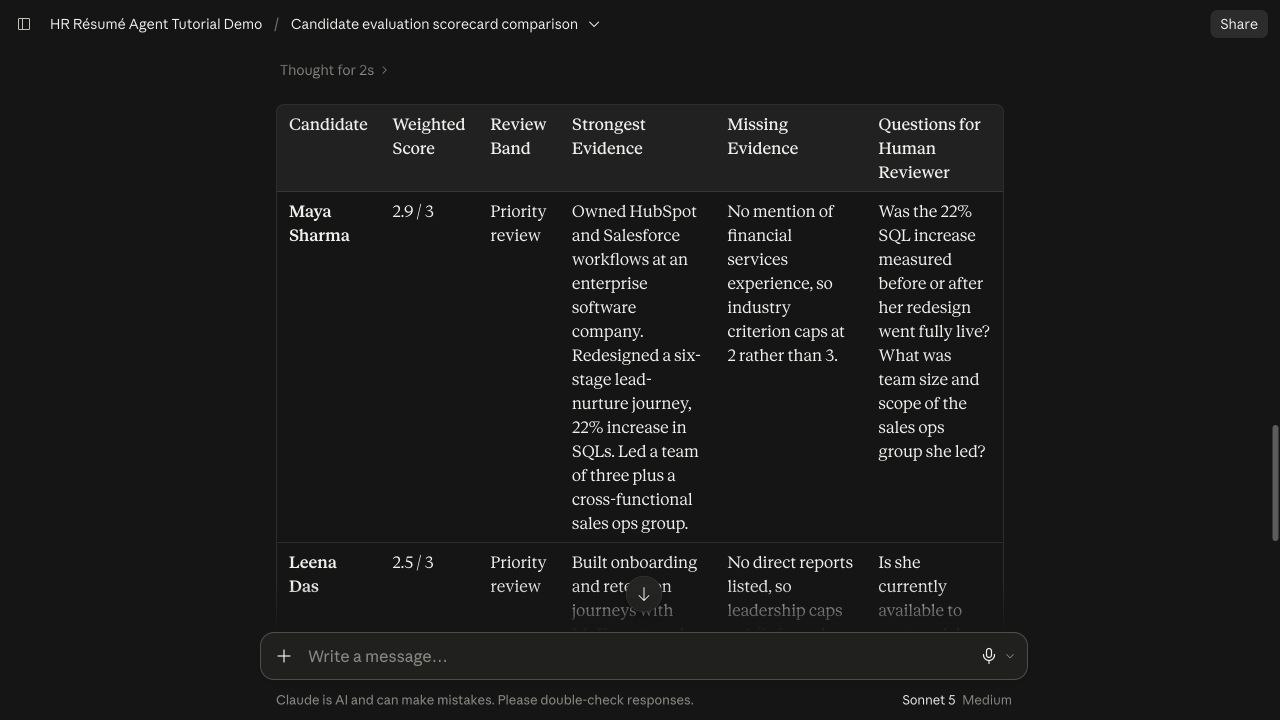
Weighted score: calculated only from the approved scorecard
Review band: a queue for human attention, not a hiring decision
Strongest evidence: direct résumé evidence supporting the score
Missing evidence: what the résumé does not establish
Questions: only job-related points a person should validate
Step 6. Challenge the output
Our first test produced an unnecessary question about why a fictional candidate had taken a career break. A human reviewer caught it. We removed the question because a career break is not job-fit evidence and should not reduce the score.
The corrected rule was simple: do not penalise a career break and do not ask why it occurred. If relevant, ask only about current availability and whether required experience remains current.
Takeaway
Human review is not a final checkbox. It is part of the system design.
Step 7. Pilot in small batches
Once the fictional test is dependable and the process is approved, run a limited real-data pilot. Compare the agent’s evidence with independent human reviews before increasing volume.
Start with a small, controlled batch
Restrict access to authorised reviewers
Record corrections and unclear cases
Keep hiring and rejection decisions with people
Pause the pilot if bias, privacy or evidence problems appear
Measure work, not novelty.
A useful pilot should improve the quality and pace of work. Track screening time, agreement with human reviewers, correction rate, shortlist quality, and bias or audit exceptions.
Takeaway
The question is not whether the agent looks impressive. The question is whether the workflow gets measurably better.
Build the agent around your business.
Our workshops use your team’s real workflows, decisions and constraints. Participants build something useful during the session and leave with a method they can use again.
Invite Team Being Relentless to build a live AI agent with your team.
Sources
1,000 Résumés. One Human Decision Queue.
A team walked into our workshop with a real HR bottleneck: more than 1,000 résumés and no fast, consistent way to review them.
We did not give them another tool demonstration. We built a working résumé-screening agent with Claude, live in the room.
Takeaway
Do not ask AI to choose the candidate. Ask it to prepare better evidence for a human decision.
We did not automate hiring.
We redesigned the first review.
The agent had one disciplined job: turn an unstructured pile of applications into a consistent, explainable queue for people to review.
Extract the same job-relevant evidence from every résumé
Score only against an approved role scorecard
Flag missing, uncertain or contradictory information
Create a prioritised queue for human review
Takeaway
The right role for AI here is decision support, not automated rejection.
Build This Résumé-Screening Agent in 30 Minutes
Start with fictional résumés. Use real candidate information only after your HR, legal and information-security teams approve the process.
Step 1. Create one Claude Project
In Claude, open Projects and create a project for the role. Give it a clear name such as HR Résumé Agent Tutorial Demo. Keep one project per role so the context does not get mixed.
Step 2. Prepare three simple files
Add the role description, the approved scorecard and a small set of fictional test résumés. The scorecard should define each criterion, its weight and what a low, medium or high score means.
job-description.txt: responsibilities, must-have requirements and useful context
approved-scorecard.txt: criteria, weights and scoring definitions
dummy-resumes.txt: three to seven fictional candidates with different evidence patterns
Step 3. Add the operating rules
Open Project Instructions and paste rules that keep the review evidence-based and human-controlled.
Copy this instruction:
You are a recruitment screening assistant. Review every résumé only against the approved scorecard. Extract evidence for every criterion. Score only with the supplied definitions. Write Not found when evidence is missing. Do not infer protected characteristics. Explain every score with evidence from the résumé. Return a comparison table with total score, review band, evidence, gaps and questions for a human reviewer. Never make a final hiring or rejection decision. End every output with: Human validation required.
Step 4. Run one controlled test
Ask Claude to review only the fictional candidates. Require one comparison table and insist that every score is tied to visible evidence.
Copy this test prompt:
Use the job description and approved scorecard in this project to review all fictional candidates in dummy-resumes.txt. Return one comparison table sorted by total score. Include candidate, weighted score, review band, strongest evidence, missing evidence and questions for a human reviewer. Use only evidence found in the files. Do not infer protected characteristics. Do not make a final hiring or rejection decision.
Step 5. Inspect the table, not just the ranking
Check whether every score has evidence, whether missing information is labelled clearly, and whether the questions are genuinely job-related. A neat table is not proof that the reasoning is sound.
Weighted score: calculated only from the approved scorecard
Review band: a queue for human attention, not a hiring decision
Strongest evidence: direct résumé evidence supporting the score
Missing evidence: what the résumé does not establish
Questions: only job-related points a person should validate
Step 6. Challenge the output
Our first test produced an unnecessary question about why a fictional candidate had taken a career break. A human reviewer caught it. We removed the question because a career break is not job-fit evidence and should not reduce the score.
The corrected rule was simple: do not penalise a career break and do not ask why it occurred. If relevant, ask only about current availability and whether required experience remains current.
Takeaway
Human review is not a final checkbox. It is part of the system design.
Step 7. Pilot in small batches
Once the fictional test is dependable and the process is approved, run a limited real-data pilot. Compare the agent’s evidence with independent human reviews before increasing volume.
Start with a small, controlled batch
Restrict access to authorised reviewers
Record corrections and unclear cases
Keep hiring and rejection decisions with people
Pause the pilot if bias, privacy or evidence problems appear
Measure work, not novelty.
A useful pilot should improve the quality and pace of work. Track screening time, agreement with human reviewers, correction rate, shortlist quality, and bias or audit exceptions.
Takeaway
The question is not whether the agent looks impressive. The question is whether the workflow gets measurably better.
Build the agent around your business.
Our workshops use your team’s real workflows, decisions and constraints. Participants build something useful during the session and leave with a method they can use again.
Invite Team Being Relentless to build a live AI agent with your team.